Somewhere late in 2021, I was on a “search-apply-receive rejection” roll as I continued to develop the Lahore Fort Project. As I became more comfortable with my rejections, I became braver and started applying to more competitive awards and opportunities too.
Enter: my application to this year’s Game Developer’s Conference, commonly referred to as the GDC. And if you do not already know what the GDC is, here is a short description.
Literally, biggest Gaming Conference around. In order to qualify to be a part of this event, you have to submit to a multi-stage peer review process, and your reviewers are going to be straight-up Gaming Pros who are insanely smart and at the top of their fields.
Knowing all of this, I felt quite safe applying to present the Lahore Fort. I figured I’d have two or three rejections before actually catching anyone’s attention.
SHOCKED!
HOLY SMOKES I CANNOT BELIEVE IT!
And I’m actually writing this post months after the actual event, so believe me, the shock LASTED quite a while!
As the semester begins to wind down, my research starts to kick back up into movement. Isn’t that always the case?
Well, I’m pleased to announce: this week I got to present The Lahore Fort Digital Preservation Project at two different venues!
The first was to a cohort of Museum Science students in Dr. Juilee Decker’s classroom.
The second was at the 6th Frameless XR Symposium at RIT!
After giving these talks, I have realized a few things:
First, I need to refresh my public-speaking skills… spending a year+ in pandemic isolation has really affected my level of comfort in front of big crowds.
Second, despite spending almost 11 years as an educator, my style of address is still distinctly more “art” than “academic”. I blame this on the fact that my medium of communication is art, not words. Also, having learned English as a second language, I don’t always understand the gobbledygooked nuance of academic jargon.
It doesn’t matter. Adaptability is a special skill that children of migrants develop young. I get better each time!
Though this post was prompted by Marvel characters, it speaks to the overall issue of how Hollywood seems to be addressing diversity as a whole.
This new trend of pulling various well-established characters out of a whole set of proverbial closets is disturbing at the very least. At worst, it is the basest and least effective way to diversify existing franchises. We’ve been seeing this for a while now, old TV shows are being rebooted in a new “diverse” light. Characters are being re-gendered, re-oriented and wrapped in new exciting racial identities with no regard to what it says about the characters, and no actual understanding of how adding a label to a person should affect storylines.
It makes one wonder whether these amazingly talented teams of creators are unaware of the implications of these changes, or if they just don’t care enough. Why are these teams so hesitant to do the very difficult work of writing authentic (and new) diverse characters into their existing storylines?
As all diverse people know, our diverse labels affect more than our appearance. We have different experiences, based on what type of diversity we represent, we make different choices in our lives and overcome a huge variety of unique hurdles to get where we are. Our experiences make us more resistant to certain types of pressures, and more vulnerable to others, and just throwing a color and an orientation onto an already established character is not a good solution to representing the complexity that comes with said labels.
Shallow changes don’t make Diverse Characters
Take, for example, the recent “coming out” of Loki, Marvel’s very popular part-time villain character from the Avengers and Thor series.
Yes, it is wonderful to see a major character in the Avengers suddenly represent the LGBTQIA+ population, however, was the villainous God of Mischief and Sower of Chaos really the best way to represent the community?
Am I the only person troubled by the idea that the Marvel team translated mischief and chaos into bisexuality? Considering how Bisexuality has for decades been a disputed orientation, even within the gay community, do we really want to tar this population with yet another connotation? Instead of shallowly indulging the diversity movement with these “blackface” rewriting techniques, how about actually creating something new?
The world has finally begun to understand and accept that diversity is not a costume and cannot be worn or discarded whenever necessary. It is not okay to dress up like a Native American or an Arab for Halloween anymore, and recently we have seen a lot of bloodthirsty call-outs to that effect. While I do think the bloodlust is overkill, the basic idea makes sense.
Still, nobody seems to notice that just recreating formerly white characters with a new orientation or a different gender (looking at you, Thor!) or adding in a little exotic blood is just as insulting as not diversifying at all.
I get that there is a need to correct the past, and that many teams are desperately looking for ways to prove that they support the presence of the “other”. However, it is important to note that the field of character design generally comes with a great deal of back-end development (or it should). An average character bio will start with basic delineations; age, race, gender, orientation, geographic location, maybe political leanings or economic status, but can get as in-depth as outlining favorite foods, allergies, medical history. Everything is on the table and anything can be relevant in the creation of a character.
Why? Because any or all of these factors will control the character’s motivation. And in story, motivation is everything.
Take, for example, Peter Parker aka Spider Man. Orphaned at a young age, economically precarious and raised in Queens, NY by his aging Aunt May. The boy was an outcast because he was super smart (a nerd), which initially made his life hell in high school until he was caught in a strange accident that gave him superpowers. It was this sharp mind that ultimately helped him process his poor choices and the empathy that comes with having experienced loss (thanks to Uncle Ben), that helped him take the noble route to superhero-dom. Had his background been more privileged, he could just as easily have been a villian instead. In fact, I’m pretty sure Harry Osborne was created to specifically illustrate that fact.
This unprivileged background and sharp mind is why Spider Man was able to be diversified into a Multiverse of characters, because his “whiteness” was not a huge contributor to the storyline. Because poverty and brains do not belong to any one race, and there are millions of smart young teens in the world who experience bullying in their lives. Unfortunately, this method of recreation should be considered the exception, not the rule in the road to diversification.
As expensive and painful as it may be, the fact is: if you want to create diverse content, stop rewriting characters that already have an existing and extensive legend. I don’t want to be reflected in your cast-offs, I want to be represented in a brand new icon, the way that poor, bullied nerd from Queens was represented 50 or 60 years ago. I want to be represented not as a big lump of, “oh this is now a gay character” or “Congratulations, Thor is a woman now”, rather, as a character that was written to be a woman and is built to represent the complexity of my gender.
I don’t want to be reflected in your cast-offs, I want to be a brand new icon.
Any organization that is actually serious about diversity and diverse representation will put their money where their diversity statements are, and actually invest in creating new content. Taking the easy way out only makes the problem worse.
Hosted by UNC Charlotte’s Atkins Library and faculty from the College of Arts + Architecture and College of Computing and Informatics. This event was made possible with a grant from UNC Charlotte’s Chancellor’s Diversity Challenge Fund.
Invited Panelists:
Latoya Peterson, Glow Up Games, CXO/Co-Founder Tara Mustapha, Code Coven, CEO and Founder Eve Crevoshay, Take This, Executive Director Mark Barlet, AbleGamers Charity, Founder Atia Newman, Rochester Institute of Technology, Associate Professor Mark Reisch, Rochester Institute of Technology, Assistant Professor
This panel was an exploration of the issues that plague the game industry today, and the kinds of research and movements that are growing to meet these challenges head on.
My most notable phrase of this event was “You can’t Google Authenticity”, which is honestly one of the most difficult things to remember during a production cycle.
Follow this diverse group of creators (and gamers) in their journey as they strive to make this industry more inclusive and more impactful on a global scale.
Questions? Contact the Diversity in Gaming organizers: Julio César Bahamón (Computer Science) – jbahamon@uncc.edu Beth Caruso (Atkins Library) – Beth.Caruso@uncc.edu Tiffany Davis (Atkins Library) – tdavi186@uncc.edu Heather D. Freeman (Art & Art History) – heatherfreeman@uncc.edu Christin Lampkowski (Atkins Library) – clampkow@uncc.edu
I was invited to speak to the Body Art and Culture class at Ringling College of Art and Design to discuss how to design diverse characters and accurately represent a culture without falling into the trap of appropriation.
This was a journey into the processes our team developed as we designed the characters for the Iroquois Creation Story.
This film was an exploration in multimedia convergence, where 2D characters interacted with 3D characters, and live actors balanced in fantastical spaces. Yet, in all this, every step of the process aimed to center the culture that the film represented, often subverting animation practices to accommodate the needs of the story and the characters.
Five years after it’s first launch, the Iroquois Creation Story (or ICS for short) is enjoying a mini-revival in 2020. With the sparking of a brand-new (old) conversation about diversity in animation and appropriate cultural representation, this project is being used as a prime example of how to respectfully represent the ideology of a nation.
Having recently given a talk on the topic of cultural appropriation, I discovered how, the more terms like “representation” and “appropriation” are bandied about, the less clear they seem to become.
Yet, in the creation of the Iroquois Creation Story we can see how possible it is to bring forward the beliefs and values of a culture without subverting it in the name of “artistic license” or stylization. Animation, like any other field of art, is merely a tool for communication and can adapt to represent any ideology.
Firstly, this film was first imagined and conceived by G. Peter Jemison, Native American artist and representative of the Seneca Nation of Indians and the manager of the Ganondagan State Historic Site. A prolific artist himself, he contributed heavily to the concept art that went into the preparation and design of this film.
As the Director of Animation (and a non-American), I could not rely on my previous stereotypical knowledge of Native American culture to design this film. It took some conscious education and examination for our creative team to deprogram ourselves from pop-culture stereoptypes. It could be so easy to justify arbitrary choices as the “rules of animation” or the “rules of character design”, but the goal of this film was to get it right, not make it easy.
So we relied heavily on the art and feedback of G. Peter Jemison, and did our best to translate the core essence of his imagery into the animated medium. Using the work of the very talented New York City-based concept artist Patricia Raubo, we built the cast of characters that would appear in this story.
Left: Original art by G. Peter Jemison. Right: Concept art for ICS by Patricia Raubo
Every character and each significant prop in this story was researched to truly understand its place in the film. Because we understood that even though the casual viewer would very likely miss such details, our core audience, the Iroquois Nation, would notice and hopefully, appreciate them.
Reference Images and Iroquois Creation Story Moodboard. All artwork by G. Peter Jemison.
With the script inspired by Chief John Arthur Gibson’s publication of the Iroquois Creation myth and the concept art in such fine state, one might expect that our adherence to representation was enough. But once you’re on the road to creation, it’s tough to stop.
All of the actors cast in this film were native Haudenosaunee speakers, so as to ensure cohesiveness in the characters, and the film was scored by award-winning composer Brent Michael Davids (Stockbridge Munsee).
Then, using the recorded dialogue we were given, our animators were directed to represent their best interpretations of their characters. These animations were then re-edited to match mannerisms and styles across characters and sections, so that each character could be believable as the owner of their voice.
This was the most significant part of my job. I was already rigging all of the characters to be animated in the film, but as the animated sections started filtering back to me, I ended up being the shadow-animator, cleaning up and refining the gestural quality of the characters.
This may sound confusing to non-animators, because why on earth would it be necessary to change or clean up someone else’s movements? But like in any collaborative process, the most difficult thing to do is create cohesion, and acting in animation is a big area of concern. Imagine asking Al Pacino to narrate one line of a story, and then asking Bruce Willis to step in for the next one. They can do their best, but their personalities can’t help but shine through. So, in order to tame this Pacino-Willis divide, I stepped in as the unifying force to ensure each character maintained continuity across sections.
Thus, when the film entered its final stages of completion, even the seemingly disparate parts came together because we had stayed faithful in color scheme and design and held each medium of animation to that standard.
Before I finish, I’ll leave you with one final thought: every film is different, and it may be impossible to duplicate the circumstance and resources that we were able to pull together for this story. But the one area that will always deserve extra time when creating a story from another culture, is your own mindset. By throwing out our “rules”, we created possibilities. By opening our development process to the culture we aimed to represent, we created authenticity.
At the end of the day, the authenticity is what drove this production and allowed it to be completed successfully.
It makes no sense to learn a program or build a new workflow without first creating an idea that you want to implement it on. After all, a theory is no good unless it has been tested and proven in some way. And what better way to establish a good workflow than to throw it into the deep end?
Visualizing two Pakistani characters.
I’ve been playing around with ideas of your typical desi (it’s a real term) women and seeing what I can create and how I can possibly stylize them. These are early concepts, so I doubt they’ll actually exist in this exact form, however, I do want to explore this style for some future idea.
Naturally, creating a natural habitat for them has been fun too, especially because I get to be all nostalgic about my old haunts during my school years. This is something I loved about my teens, nobody seemed to care where we went as long as we came back safe and sound. Maybe it’s like those memes about how 80’s parents never cared about their kids, and now we can’t get away from helicopter parents. But I’d like to think that life could get there again. After all, neighborhoods are created by people, and if we work to make our neighborhoods safe, then why wouldn’t our kids find fun places to go hang out, drink some chai and shoot the breeze with friends?
Not any specific location, but every Karachiite on the planet should have a moment of nostalgia looking at this drawing. All that’s missing is a stray cat and some guy handing out tea.
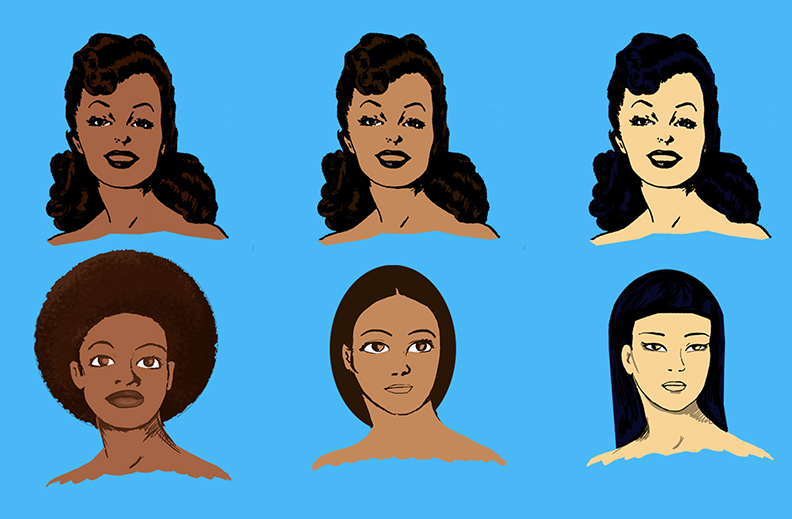
The Character Mosaic Project aims to increase representation of minorities and under served populations by making a number of ethnically accurate characters available online. The hope is to encourage animators and artists to produce more relevant and empathetic stories for broader audiences, and to allow young children to see themselves in their favorite stories.
To learn more, you can view our project pitch here:
The Character Mosaic Project aims to make diverse characters more accessible thereby encouraging animators and filmmakers to make more ethnically inclusive stories.
As these characters get refined, they will be made available to broader audiences as international and domestic animation professionals will be able to use them in their films as well. This project will bring attention to (and address) a very important issue in mainstream media and step away from limited stereotypes and unfair projections.
Sheryl Browne Graves speaks to this directly in the Journal of Social Issues:
“Television programming provides information about social groups in two ways: by inclusion and by
exclusion. When diverse groups are included, television content offers specific examples of the
physical, psychological, social, cultural, and economic characteristics of each group. However when
groups are absent from the television curriculums there is implication that the missing groups are
unimportant, inconsequential, and Powerless. Both types of information can contribute to the
development, maintenance, and modification of children's thoughts, feelings, and actions towards
racial/ethnic groups.”
It is hoped these characters will begin a new movement to represent a multitude of nationalities and
cultures around the world. By creating meaningful characters we hope to provide a new cast of
role-models for younger generations, thereby allowing them to empathize with other races and
cultures and attribute a sense of familiarity to them.