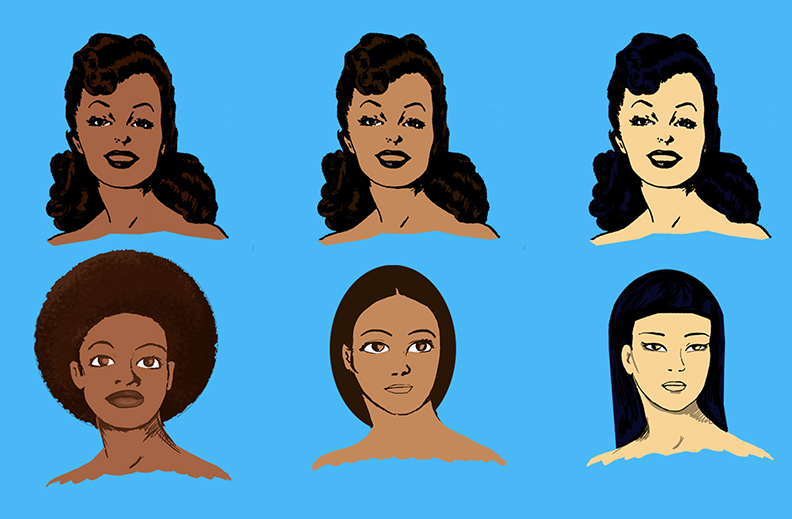
Though this post was prompted by Marvel characters, it speaks to the overall issue of how Hollywood seems to be addressing diversity as a whole.
This new trend of pulling various well-established characters out of a whole set of proverbial closets is disturbing at the very least. At worst, it is the basest and least effective way to diversify existing franchises. We’ve been seeing this for a while now, old TV shows are being rebooted in a new “diverse” light. Characters are being re-gendered, re-oriented and wrapped in new exciting racial identities with no regard to what it says about the characters, and no actual understanding of how adding a label to a person should affect storylines.
It makes one wonder whether these amazingly talented teams of creators are unaware of the implications of these changes, or if they just don’t care enough. Why are these teams so hesitant to do the very difficult work of writing authentic (and new) diverse characters into their existing storylines?
As all diverse people know, our diverse labels affect more than our appearance. We have different experiences, based on what type of diversity we represent, we make different choices in our lives and overcome a huge variety of unique hurdles to get where we are. Our experiences make us more resistant to certain types of pressures, and more vulnerable to others, and just throwing a color and an orientation onto an already established character is not a good solution to representing the complexity that comes with said labels.

Take, for example, the recent “coming out” of Loki, Marvel’s very popular part-time villain character from the Avengers and Thor series.
Yes, it is wonderful to see a major character in the Avengers suddenly represent the LGBTQIA+ population, however, was the villainous God of Mischief and Sower of Chaos really the best way to represent the community?
Am I the only person troubled by the idea that the Marvel team translated mischief and chaos into bisexuality? Considering how Bisexuality has for decades been a disputed orientation, even within the gay community, do we really want to tar this population with yet another connotation? Instead of shallowly indulging the diversity movement with these “blackface” rewriting techniques, how about actually creating something new?
The world has finally begun to understand and accept that diversity is not a costume and cannot be worn or discarded whenever necessary. It is not okay to dress up like a Native American or an Arab for Halloween anymore, and recently we have seen a lot of bloodthirsty call-outs to that effect. While I do think the bloodlust is overkill, the basic idea makes sense.
Still, nobody seems to notice that just recreating formerly white characters with a new orientation or a different gender (looking at you, Thor!) or adding in a little exotic blood is just as insulting as not diversifying at all.
I get that there is a need to correct the past, and that many teams are desperately looking for ways to prove that they support the presence of the “other”. However, it is important to note that the field of character design generally comes with a great deal of back-end development (or it should). An average character bio will start with basic delineations; age, race, gender, orientation, geographic location, maybe political leanings or economic status, but can get as in-depth as outlining favorite foods, allergies, medical history.
Everything is on the table and anything can be relevant in the creation of a character.
Why? Because any or all of these factors will control the character’s motivation. And in story, motivation is everything.
Take, for example, Peter Parker aka Spider Man. Orphaned at a young age, economically precarious and raised in Queens, NY by his aging Aunt May. The boy was an outcast because he was super smart (a nerd), which initially made his life hell in high school until he was caught in a strange accident that gave him superpowers. It was this sharp mind that ultimately helped him process his poor choices and the empathy that comes with having experienced loss (thanks to Uncle Ben), that helped him take the noble route to superhero-dom. Had his background been more privileged, he could just as easily have been a villian instead. In fact, I’m pretty sure Harry Osborne was created to specifically illustrate that fact.

This unprivileged background and sharp mind is why Spider Man was able to be diversified into a Multiverse of characters, because his “whiteness” was not a huge contributor to the storyline.
Because poverty and brains do not belong to any one race, and there are millions of smart young teens in the world who experience bullying in their lives.
Unfortunately, this method of recreation should be considered the exception, not the rule in the road to diversification.
As expensive and painful as it may be, the fact is: if you want to create diverse content, stop rewriting characters that already have an existing and extensive legend. I don’t want to be reflected in your cast-offs, I want to be represented in a brand new icon, the way that poor, bullied nerd from Queens was represented 50 or 60 years ago. I want to be represented not as a big lump of, “oh this is now a gay character” or “Congratulations, Thor is a woman now”, rather, as a character that was written to be a woman and is built to represent the complexity of my gender.
I don’t want to be reflected in your cast-offs, I want to be a brand new icon.
Any organization that is actually serious about diversity and diverse representation will put their money where their diversity statements are, and actually invest in creating new content.
Taking the easy way out only makes the problem worse.


