Another wonderful experience and my first trip to North Carolina. The FACSS stands for The Federations of Analytical Chemistry and Spectroscopy Societies, and the SciX Conference represents the Great Scientific Exchange, a conference that has been running since 1974.
This year marks the 50th year of this international conference at the forefront of analytical chemistry and allied sciences. A small contingent of Digital Preservationists from RIT formed a panel presentation and got to share their work with today’s scientist community.
I am very grateful to have been included in that team, thanks to CHIPR and Dr Juilee Decker.
The most frustrating thing about being someone interested in too many things is that I am always struggling to record and post updates on all of the millions of developments that arise each week. This problem was never more pronounced than in 2023. This year, I was not only completing my second year as the Faculty Senate Chair of RIT, traveling to the GDC (again), co-leading a Global Campus summit, speaking at the Day of Understanding and Solidarity and continuing to develop and refine my digital preservation project, which included being showcased in the Wehrheim Gallery, bringing on collaborators, applying for funding and working with a career coach to develop my skills as a leader and creator.
Oh, and I decided I was also going to have a personal life, so from May onwards, I worked out 3 times a week, cooked my own food, went on a lovely family trip to the UK and developed some sort of weird inflammatory response from the Canadian wildfires that forced Rochesterians to stay indoors to avoid the horrible smoke. This led me to a bunch of doctors who decided that I had a deviated septum and recommended an operation, which I got done two days before Christmas. Needless to say, it was a sleepy New Year for me!
Okay, on to our updates: 2023 was the year of internal growth.
Research
After my presentation at the GDC in 2022, I was pleasantly surprised (and overjoyed) to learn that my talk was one of the highest-ranked presentations of the year. This earned me a spot in the much-vaunted GDC card-deck, a commemoration of the best talks of the year.
Boosted by this knowledge, I applied to the Ambassador’s Cultural Preservation Fund with the US Embassy in Pakistan, building connections and moving past the first round for consideration. Unfortunately, this process was stalled when the Pakistan government was overthrown in a coup and by the time I got a response for my application, all funding had ceased.
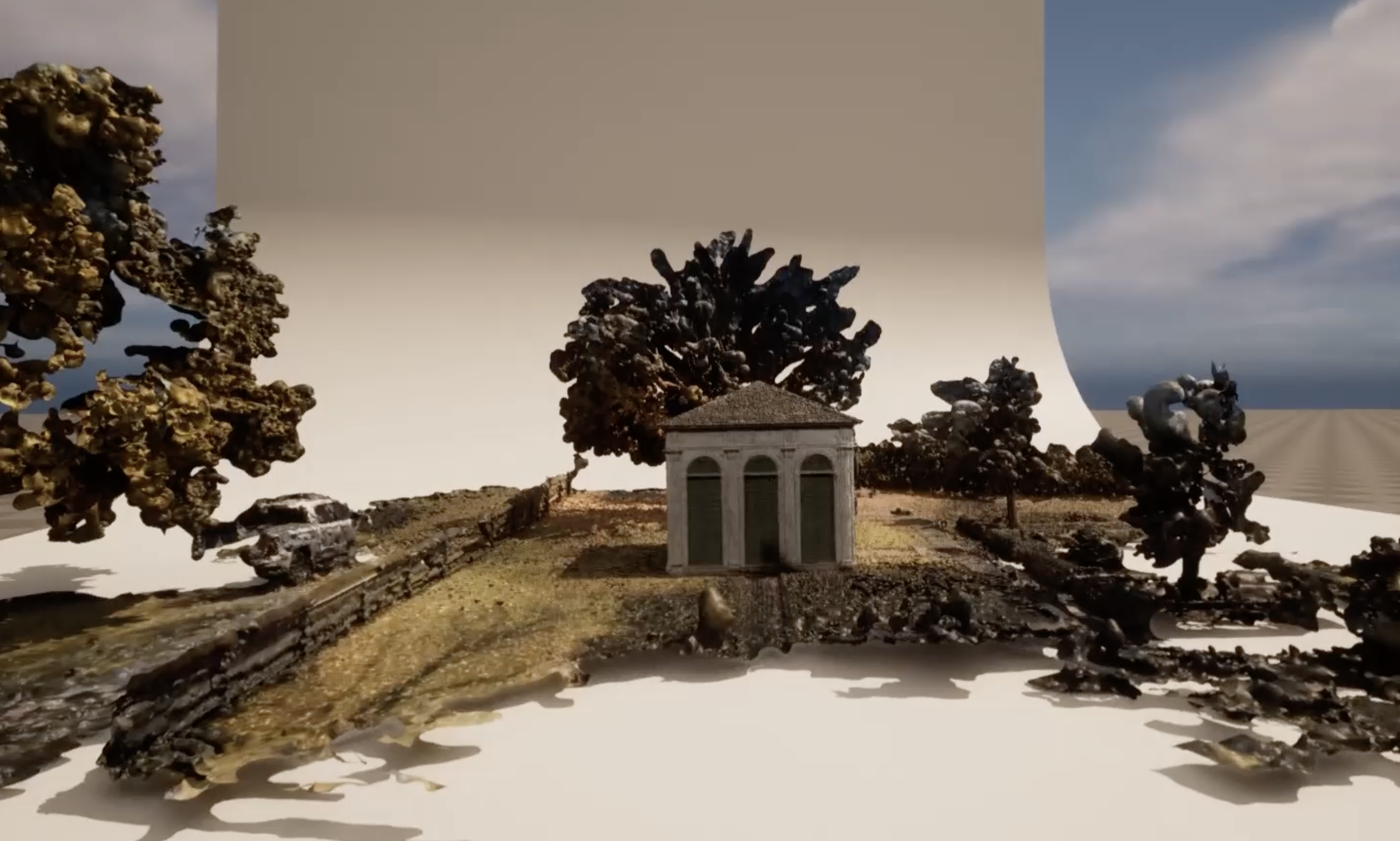
Instead, I decided to continue the work I had started in the Fall semester of 2022 (I just realized, I haven’t posted about this yet…) and to refine the test export of the building I and my students had scanned. As I did that, I also asked for user feedback from a couple of Architecture and Museum courses to see how the different audiences experience the scanned world.
This project gets more exciting every time I get to present it to different audiences. I will put up a post specifically to discuss recent strategies and goals that I and my collaborators are cooking up!
Leadership
Besides my research, this was also a banner year for me as a leader. Not only was I elected to Faculty Senate Chair for a second year, but we were able to put a whole set of my ideas into practice. Starting last year, the Senate established a full-on calendar, which was amplified by our Newsletter (which I set up the year prior). The Executive Committee visited every single college and unit, and discussed in person the policies and issues with our faculty. Keeping names and populations unnamed, we honed in on some key issues plaguing our faculty and began to actively work with different administrative offices to begin to address the concerns. The COACHE survey also came out this year and provided us with even more ammunition to advocate for a better system of governing.
This is the year I realized I had a talent for leadership. Not only was I able to defuse volatile situations and amplify concerns voiced to me, but I realize I am surprisingly good at breaking bad news to my superiors without being insolent or insulting. The fact is, without communication, everyone is working blindly, and it really helps to shed light on different perspectives.
Additionally, my team and I were able to develop a comprehensive set of adjustments that will refine how we build our policies and will make us (the RIT Faculty Senate) much more nimble in how we approach and solve problems in the future. I feel braggy saying this, but I feel like I have a knack for organizational refinement. I attribute this to my skills in 3D rigging, because the job always demands solving problems before they arise, it really gives me the ability to see big things coming down the road.
In retrospect
As much as I’d like to have listed some clear wins for 2023, I realize I hadn’t set up enough small and attainable goals for myself to aim for. Instead, I was forced to slow down and put in the kind of deep work that must be done in order for true progress to be made. Of course, our shallow metrics for measuring academic progress are not equipped for such work, so naturally I received a less than great review for my efforts, but I’ve come to the conclusion that I will never be valuable to my leadership.
Instead, I decided to be flattered by the many invitations I received to apply for leadership roles in other institutions. This is what prompted even more deep thinking as I worked with my coach to explore what types of opportunities excited me. I didn’t end the year with a single goal, nor did I have the kind of clarity I was aiming for, but I did finally get the sense that I was getting unstuck from the quagmire that has been blocking me for years. Living and working in a toxic environment can do that to a person, and getting to detach and interact with real people, active researchers and academics the like of whom I discovered through the Senate was just what I needed. I feel like I found my community and I’m grateful to have at least one more year with them. (Spoiler: I was re-elected to Faculty Senate Chair for a 3rd time in 2024! That’s got to be some sort of a record!?)
Now it’s 2024 and I’m shocked to realize it’s almost August.
It’s already been an insanely busy year, with some key wins (yes, clear wins!) and great strides being made in all areas of my life. As tempted as I am to cram it all into this one update, I will hold off, and give myself homework to write updates in discrete headings so that people can find them more easily.
Exciting news continues! I won the Frank J Romano Endowed Prize for innovative use of technology working with students. The Digital Preservation Process has evolved into the Digital Interactive Preservation method, or DIP method.
Two reasons for this: one, because the RIT CHIP Research group, led by Dr Juilee Decker and Dr David Messinger has been such a powerful source of support for my research. Two, CHIP and DIP make a wonderful pairing!
So grateful for this show of support from my college. The DIP method has continued to expand and is living up to my initial assertions of the need to bring multiple fields of study together to ensure the best possible results.
The DIP team has formally expanded to include the active participation of the RIT Sustainable Architecture program, with Dr Alissa De Wit-Paul joining me as co-PI in all of our applications for funding and support going forward.
Even more exciting is the participation of students from animation, 3D Digital Design, Museum Sciences and architecture in our next venture.
Special thanks to the Genesee Country Village and Museum, the RIT Center for Imaging Sciences and, of course RIT’s leadership for their support of our research.
What a wild ride!! If you’ve never had a chance to go, I highly recommend attending the Game Developer’s Conference. Feel like stepping it up? Go as a speaker!
There were a number of awesome things about this conference, not least the fact that 2022 had a much bigger in-person attendance than any post-pandemic year. After being really isolated through the pandemic, this was both an exhilarating and terrifying experience.
Getting to spend a week immersed in the world of game creation, watching and learning from the gurus of the industry and being surrounded with that level of talent is inspiring on so many levels. I attended talks about the state of the industry, learned about art, management, marketing, and the metaverse.
For me, the GDC was (is) the most prestigious place I had ever gotten to present my idea. Even carzier was the fact that there were a few other talks related to cultural heritage development and preservation. Knowing this made me feel like my idea had real merit!
My talk was scheduled for Friday afternoon, the last day of the conference in the final timeslot of the conference. That entire week, I vacillated between gratitude at the idea of not drawing any attendees for my talk, and the imagined horror of potentially having to present to an empty hall.
I rewrote my speech about a hundred times and kicked myself for applying to speak in the first place. After all, I was presenting an idea that was remarkably simple in its technical scope. I had zero proof-of-concept examples, other than some minor tests based on my own photography of a monument. My research and references focused more on games and non-academic worlds than on actual real-life cultural sites. I had nightmares about being booed off stage by game professionals who were angry that I had wasted their time with a dumb idea.
The rest of the time, I attempted to network with people in the various social events of the week. I talk to my students a lot about the importance of networking. I need to go over my notes more carefully next time, because I’m still really bad at it! 🙂
Friday afternoon came, I was nervous but ready, and the doors opened. I was shocked when one stranger walked in, then flabbergasted when more and more attendees started coming in. Ultimately, the crowd was about two to three times the size of my average classroom, and I began to speak.
The thirty-minutes just flew by and I completed my speech without being booed. Then I got questions, and more, until we ended up being moved out into an overflow room!
My mind was buzzing with excitement. I made a bunch of connections with people excited about this topic and excited to explore opportunities to collaborate. The craziest moment was when I was approached by the Director of the Cultural Antiquities Task Force from the US Department of State to explore ways to support my project both through funding and through introductions!
Brimming with hope and the possibility of making significant progress on this project, I barely needed the plane to fly home!
Somewhere late in 2021, I was on a “search-apply-receive rejection” roll as I continued to develop the Lahore Fort Project. As I became more comfortable with my rejections, I became braver and started applying to more competitive awards and opportunities too.
Enter: my application to this year’s Game Developer’s Conference, commonly referred to as the GDC. And if you do not already know what the GDC is, here is a short description.
Literally, biggest Gaming Conference around. In order to qualify to be a part of this event, you have to submit to a multi-stage peer review process, and your reviewers are going to be straight-up Gaming Pros who are insanely smart and at the top of their fields.
Knowing all of this, I felt quite safe applying to present the Lahore Fort. I figured I’d have two or three rejections before actually catching anyone’s attention.
SHOCKED!
HOLY SMOKES I CANNOT BELIEVE IT!
And I’m actually writing this post months after the actual event, so believe me, the shock LASTED quite a while!
I’m happy to report that I presented my Digital Preservation Project at the Global XR Conference in Dec of 2021. New year, lots of hope! Exciting to get feedback from a European conference and see what other researchers are doing in this space.
The presentation should be available online to view for free in the coming months.
As the semester begins to wind down, my research starts to kick back up into movement. Isn’t that always the case?
Well, I’m pleased to announce: this week I got to present The Lahore Fort Digital Preservation Project at two different venues!
The first was to a cohort of Museum Science students in Dr. Juilee Decker’s classroom.
The second was at the 6th Frameless XR Symposium at RIT!
After giving these talks, I have realized a few things:
First, I need to refresh my public-speaking skills… spending a year+ in pandemic isolation has really affected my level of comfort in front of big crowds.
Second, despite spending almost 11 years as an educator, my style of address is still distinctly more “art” than “academic”. I blame this on the fact that my medium of communication is art, not words. Also, having learned English as a second language, I don’t always understand the gobbledygooked nuance of academic jargon.
It doesn’t matter. Adaptability is a special skill that children of migrants develop young. I get better each time!
Hosted by UNC Charlotte’s Atkins Library and faculty from the College of Arts + Architecture and College of Computing and Informatics. This event was made possible with a grant from UNC Charlotte’s Chancellor’s Diversity Challenge Fund.
Invited Panelists:
Latoya Peterson, Glow Up Games, CXO/Co-Founder Tara Mustapha, Code Coven, CEO and Founder Eve Crevoshay, Take This, Executive Director Mark Barlet, AbleGamers Charity, Founder Atia Newman, Rochester Institute of Technology, Associate Professor Mark Reisch, Rochester Institute of Technology, Assistant Professor
This panel was an exploration of the issues that plague the game industry today, and the kinds of research and movements that are growing to meet these challenges head on.
My most notable phrase of this event was “You can’t Google Authenticity”, which is honestly one of the most difficult things to remember during a production cycle.
Follow this diverse group of creators (and gamers) in their journey as they strive to make this industry more inclusive and more impactful on a global scale.
Questions? Contact the Diversity in Gaming organizers: Julio César Bahamón (Computer Science) – jbahamon@uncc.edu Beth Caruso (Atkins Library) – Beth.Caruso@uncc.edu Tiffany Davis (Atkins Library) – tdavi186@uncc.edu Heather D. Freeman (Art & Art History) – heatherfreeman@uncc.edu Christin Lampkowski (Atkins Library) – clampkow@uncc.edu
I was invited to speak to the Body Art and Culture class at Ringling College of Art and Design to discuss how to design diverse characters and accurately represent a culture without falling into the trap of appropriation.
This was a journey into the processes our team developed as we designed the characters for the Iroquois Creation Story.
This film was an exploration in multimedia convergence, where 2D characters interacted with 3D characters, and live actors balanced in fantastical spaces. Yet, in all this, every step of the process aimed to center the culture that the film represented, often subverting animation practices to accommodate the needs of the story and the characters.